

What Are Pressure Measurement and Control Instruments?
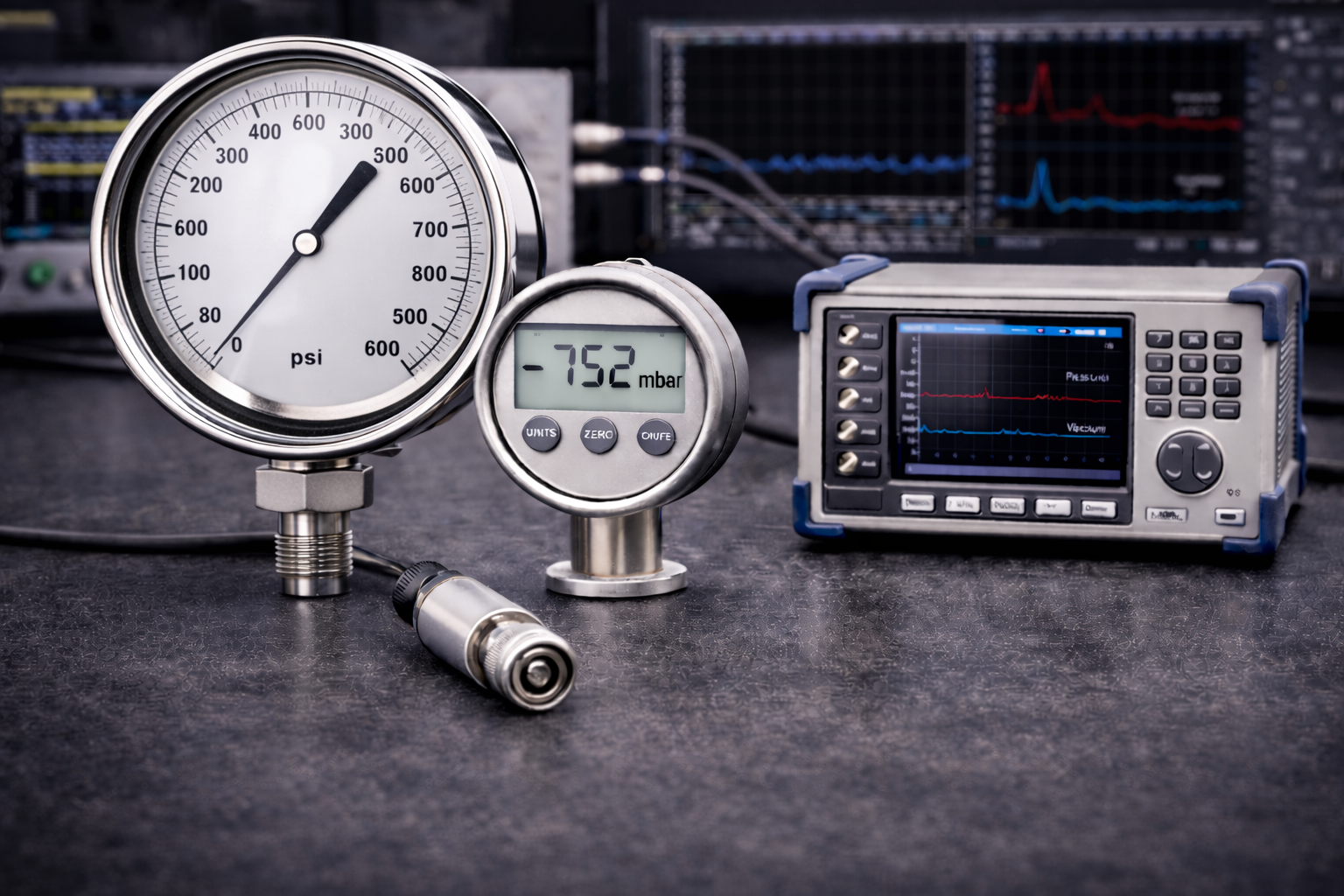
Pressure measurement and control instruments are used to measure, monitor, or regulate pressure in pneumatic, hydraulic, vacuum, process, and test systems. Depending on their design, these instruments may measure gauge pressure, absolute pressure, or differential pressure. Other devices, such as pressure switches, respond when pressure reaches a specified setting.
These instruments are commonly used in manufacturing, aerospace and defense, medical device production, biotechnology, semiconductor processing, electronics, energy, and industrial environments. They support product quality, process control, equipment performance, safety, and compliance.
Regular calibration helps establish the measurement or operating performance of these devices and provides traceable results that can be used to evaluate whether they continue to meet applicable requirements.
How Do Pressure Instruments Work?
Pressure instruments use mechanical, electronic, or fluid-based sensing methods to detect pressure or respond to pressure changes.
Mechanical instruments commonly use Bourdon tubes, diaphragms, or bellows that move when pressure is applied. This movement can operate a pointer, activate a switch, or provide a mechanical indication of pressure.
Electronic instruments use pressure sensors that convert applied pressure into electrical signals. These signals may be displayed as pressure readings, transmitted to monitoring systems, or used to control equipment.
Other instruments, such as liquid-column manometers, determine pressure from the height difference between columns of liquid.
Although these instruments use different operating principles, calibration generally involves applying known reference pressures and evaluating the instrument’s response. The specific calibration method depends on the instrument design, measurement range, and required performance characteristics.
Common Pressure Instruments SIMCO Calibrates
SIMCO supports calibration for a variety of pressure measurement and control instruments, including:
- Pressure Gauge Calibration: Mechanical pressure gauges typically use Bourdon tubes, diaphragms, or bellows to indicate pressure, while digital pressure gauges use electronic sensors. Calibration evaluates the indicated pressure against reference values across applicable measurement points.
- Pressure Transducer Calibration: Pressure transducers convert applied pressure into electrical signals, commonly expressed in mV/V or as conditioned voltage outputs. Calibration evaluates the relationship between applied pressure and the resulting electrical output.
- Pressure Transmitter Calibration: Pressure transmitters provide an electrical output, commonly 4–20 mA, representing measured pressure. Calibration evaluates the output signal at specified reference pressures.
- Pressure Switch Calibration: Pressure switches change their electrical state when pressure reaches a specified setting. Calibration evaluates actuation and reset pressures, when applicable, against specified requirements.
- Manometer Calibration: Manometers use liquid columns, mechanical sensing elements, or electronic sensors to measure pressure. Calibration evaluates their indicated pressure against reference values, including low-pressure and differential pressure applications.
- Digital Pressure Indicator Calibration: Digital pressure indicators display pressure measurements from internal or external sensors. Calibration evaluates the accuracy of the displayed pressure.
- Pressure Controller Calibration: Pressure controllers regulate pressure using measurement feedback and control mechanisms. Calibration evaluates pressure indication and control performance, as applicable.
- Pressure Calibrator Calibration: Pressure calibrators generate, measure, or control pressure for testing other instruments. Calibration evaluates their pressure measurement or generation performance across supported ranges.
- Barometer Calibration: Barometers measure atmospheric pressure. Calibration evaluates their readings against appropriate absolute pressure references.
- Vacuum Gauge Calibration: Vacuum gauges measure pressures below atmospheric pressure. Calibration evaluates their measurement performance across supported vacuum ranges.
Available calibration capabilities depend on instrument design, pressure range, measurement requirements, and service location.
Pressure Calibration Capabilities
SIMCO provides pressure calibration services designed to evaluate measurement performance, identify changes in instrument accuracy, and support traceable documentation for quality and compliance programs.
Our pressure calibration services may include:
- Inspection of instrument condition, fittings, pressure ports, displays, controls, and accessories.
- Gauge pressure calibration for instruments measuring pressure relative to ambient atmospheric pressure.
- Absolute pressure calibration for instruments measuring pressure relative to a vacuum reference.
- Differential pressure calibration for instruments measuring the pressure difference between two points.
- Vacuum calibration across supported pressure ranges.
- Pressure switch actuation and reset point verification, when applicable.
- Pressure controller and calibrator performance verification.
- Multi-point calibration across applicable measurement ranges.
- Calibration in common pressure units, including psi, bar, kPa, inH₂O, mmHg, and torr.
- Calibration using appropriate pressure reference standards and compatible pressure media.
- Leak, stability, and response checks, when applicable.
- Adjustment, when supported by the instrument and service scope.
- As-found and as-left measurement results, when required.
- Calibration certificates documenting applicable test points, measurement results, tolerances, measurement uncertainties, and metrological traceability.
Calibration procedures, test points, and acceptance requirements are selected based on the instrument, applicable specifications, and requested service requirements.
Why Pressure Calibration Matters
Pressure instruments can experience changes in measurement performance due to mechanical stress, overpressure, vibration, temperature changes, contamination, component aging, or normal wear.
These changes may affect pressure readings, control settings, or switching performance. Measurement errors can influence process control, product quality, equipment testing, environmental monitoring, and safety-related decisions.
Pressure calibration helps support:
- Measurement Accuracy: Establishes measurement errors and provides evidence for evaluating instrument performance against applicable tolerances.
- Process Reliability: Supports consistent pressure monitoring and control in pneumatic, hydraulic, vacuum, cleanroom, and production systems.
- Equipment Performance: Helps identify changes in pressure measurement and switching characteristics that may affect equipment operation.
- Compliance and Audit Readiness: Provides traceable calibration documentation supporting quality systems, customer requirements, and regulated applications.
- Risk Reduction: Helps identify measurement problems that could contribute to incorrect test results, process variation, product holds, rework, or equipment downtime.
Calibration Service Options
SIMCO supports calibration programs through a range of service models designed to meet different operational, compliance, and turnaround requirements.
Depending on instrument type, service scope, location, and quality requirements, available options may include:
- In-Lab Calibration: Calibration performed through SIMCO’s laboratory network.
- Onsite Calibration: Calibration performed at customer facilities, including supported installed equipment.
- Embedded Laboratories: Onsite, fully managed calibration laboratories.
- Managed Outside Services: Coordination of calibration services through qualified outside providers.
- Pickup and Delivery: Local transportation services available in supported service areas.
Explore Calibration Service Options
Industries and Applications We Support
SIMCO supports pressure calibration for organizations where accurate pressure measurements, traceability, process control, and equipment performance are important.
Common applications include:
- Aerospace and defense pneumatic, hydraulic, and environmental control systems.
- Medical device and biotechnology manufacturing.
- Pharmaceutical manufacturing and controlled process environments.
- Semiconductor and electronics manufacturing.
- Industrial manufacturing, automation, and quality control.
- Power generation, energy, and utility operations.
- Cleanroom monitoring and differential pressure applications.
- Leak testing, pressure testing, and equipment validation.
Why Choose SIMCO for Pressure Calibration?
- ISO/IEC 17025 accredited pressure calibration capabilities.
- Calibration support for pressure gauges, transducers, transmitters, switches, manometers, indicators, controllers, calibrators, and other supported instruments.
- Support for gauge, absolute, differential, and vacuum pressure measurements.
- Multi-point calibration across applicable pressure ranges and measurement units.
- Calibration documentation with test points, tolerances, measurement uncertainties, and traceable results.
- As-found and as-left measurement data available when required.
- Calibration support for regulated and high-precision industries.
- Service options including in-lab, onsite, embedded laboratories, managed outside services, and pickup and delivery.
- Calibration asset management support through CERDAAC SIMCO Manager.