

What is a Data Acquisition Unit?
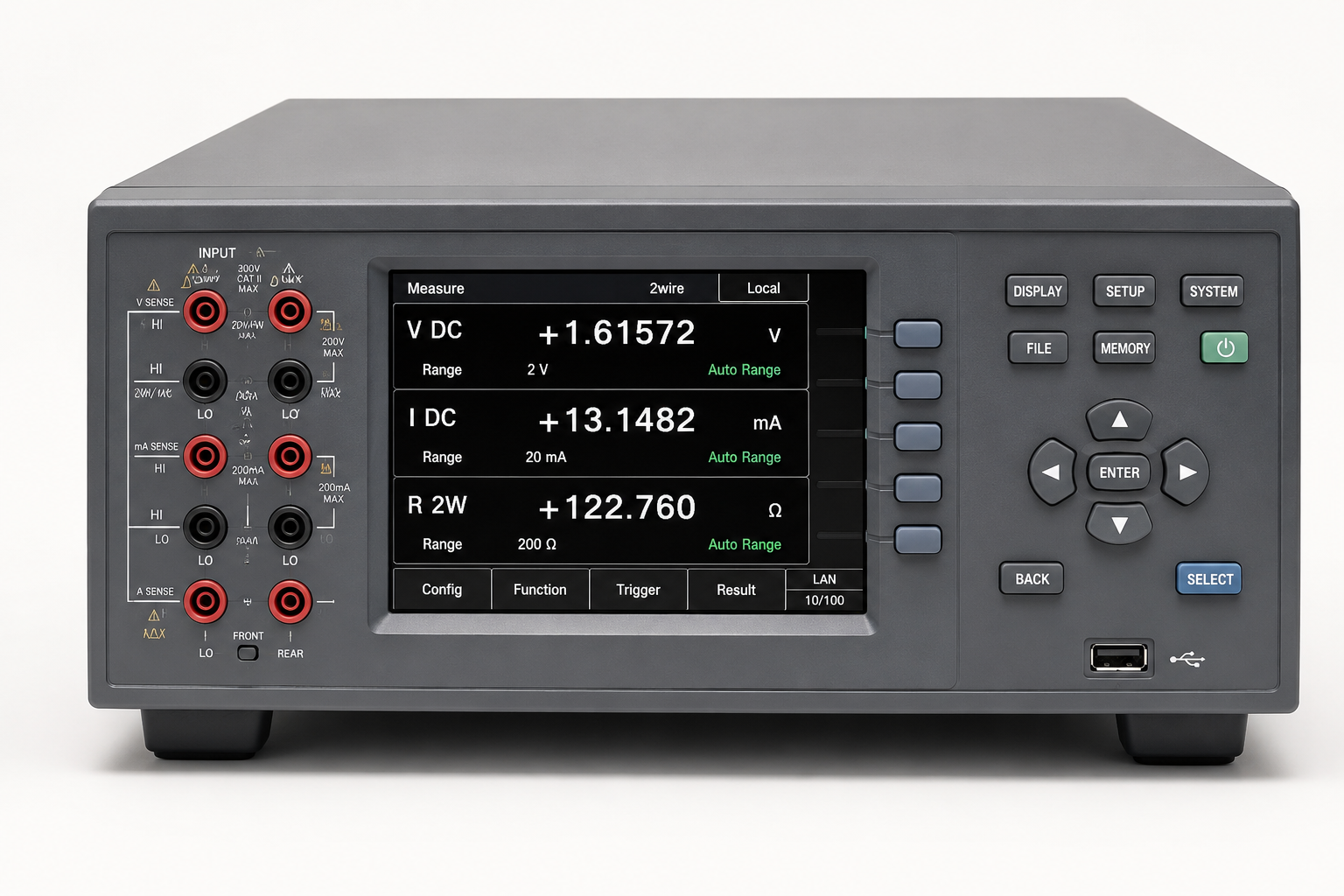 A data acquisition unit (DAU), often called a data acquisition system (DAQ), is an electronic instrument that measures signals from sensors, transducers, and other test devices, converts those signals into digital data, and records or transfers the information for analysis.
Depending on the instrument configuration, DAQ systems can measure voltage, current, resistance, frequency, temperature, strain, pressure, and other physical parameters across one or many input channels. Many systems also include built-in signal conditioning, channel scanning, switching, multiplexing, and data logging capabilities that allow measurements from multiple sensors to be collected automatically.
Many modern data loggers are designed as data acquisition systems and share many of the same measurement functions. As a result, calibration principles are similar, with the scope of calibration determined by the instrument’s supported measurement capabilities.
Many data acquisition systems are modular, allowing users to install different measurement modules for specific applications. These modules may support electrical measurements, temperature sensing, strain measurements, switching, or other specialized functions. As a result, the calibration scope depends on the installed modules and the measurement functions supported by the instrument.
Data acquisition units are widely used in aerospace and defense, electronics manufacturing, automotive testing, medical device production, life sciences, energy, research laboratories, environmental monitoring, product validation, and industrial process control. Because the data they collect often supports engineering decisions, product quality, regulatory compliance, and scientific research, regular calibration helps confirm that measurements remain accurate, traceable, and reliable.
Common Data Acquisition Measurement Capabilities
SIMCO supports calibration for data acquisition units and DAQ systems with common measurement capabilities, including:
- DC voltage measurements
- AC voltage measurements, where supported
- DC current measurements
- Resistance measurements
- Thermocouple inputs
- RTD measurements
- Thermistor measurements
- Frequency measurements
- Strain gage measurements
- Pressure transducer inputs, where applicable
- Signal conditioning verification, where applicable
- Data logging verification
- Multi-channel scanning systems
- Switching and multiplexer functions, where applicable
Data Acquisition Unit Calibration Capabilities
SIMCO provides data acquisition unit calibration services designed to verify measurement accuracy, identify drift, and support traceable documentation for quality and compliance programs.
Our calibration services may include:
- Inspection of instrument condition, connectors, displays, controls, and accessories
- Verification of supported electrical measurement functions
- Verification of signal conditioning functions, where applicable
- Temperature channel verification using thermocouple, RTD, or thermistor simulation, when applicable
- Multi-channel measurement verification across supported input ranges
- Verification of scanning, switching, and multiplexer functions, where applicable
- Calibration using appropriate reference standards and documented procedures
- Adjustment, when supported by the instrument and service scope
- As-found and as-left results, when required
- Calibration certificates with test points, tolerances, measurement uncertainties, and traceable documentation
Why Data Acquisition Unit Calibration Matters
Data acquisition units can drift over time due to normal use, component aging, environmental conditions, electrical stress, vibration, and temperature changes. Because many DAQ systems monitor multiple measurement channels simultaneously, even small changes in measurement performance can affect large amounts of collected data.
Instruments with integrated signal conditioning can also experience changes in gain, offset, or other signal processing characteristics that influence the accuracy of sensor measurements. Calibration helps verify the performance of both the measurement channels and supported signal conditioning functions.
Inaccurate measurements may lead to incorrect engineering decisions, failed product validation, inaccurate environmental testing, improper process adjustments, unnecessary troubleshooting, or quality escapes. Measurement errors may also affect long-term data trending, automated pass/fail decisions, and the performance of monitoring systems that rely on accurate sensor inputs.
Regular calibration helps support:
Measurement accuracy: Confirms voltage, current, temperature, resistance, frequency, strain, and other measurement channels perform within required tolerances.
Compliance and audit readiness: Provides traceable documentation that supports quality systems, customer requirements, and regulated industries.
Risk reduction: Helps reduce inaccurate data collection, failed testing, unnecessary rework, incorrect troubleshooting, and process variation caused by measurement errors.
Operational confidence: Supports consistent measurement performance for engineering, manufacturing, research, validation, environmental testing, automated data acquisition systems, and long-term monitoring applications.
Calibration Service Options
SIMCO supports calibration programs through a range of service models designed to meet different operational, compliance, and turnaround requirements.
Depending on your instrument type, service scope, location, and quality requirements, available options may include:
- In-Lab Calibration: Instruments calibrated through SIMCO’s ISO/IEC 17025 accredited laboratory network
- Onsite Calibration: Calibration performed at your facility, including installed equipment when practical
- Embedded Laboratories: Fully managed onsite calibration laboratories
- Managed Outside Services: Coordinated third-party calibration management
- Pickup and Delivery: Local pickup and delivery options available for SIMCO service areas
Industries and Applications We Support
SIMCO supports DAQ and DAU calibration for organizations where accurate data collection and traceable measurements are essential.
Common applications include:
- Aerospace and defense
- Automotive and electric vehicle testing
- Electronics and semiconductor manufacturing
- Medical device and life sciences manufacturing
- Energy and utility operations
- Industrial process monitoring
- Environmental testing and monitoring
- Research and development laboratories
- Product validation and qualification testing
- Manufacturing quality control
Common Data Acquisition Unit Manufacturers
SIMCO calibrates many brands of data acquisition units and systems, including equipment from manufacturers such as:
- Agilent Technologies
- Hewlett Packard (HP)
- Keysight Technologies
- Keithley
- National Instruments (NI)
- Fluke
- Yokogawa
- Hioki
- Graphtec
- Dewesoft
- HBK (Hottinger Brüel & Kjær)
- Campbell Scientific
- AstroNova
Calibration capabilities vary depending on the manufacturer, model, installed modules, and supported measurement functions.
Frequently Asked Questions
What is the difference between a DAQ and a DAU?
The terms DAQ (Data Acquisition System) and DAU (Data Acquisition Unit) are often used interchangeably. Both refer to instruments that collect measurement data from sensors and convert it into digital information for storage, monitoring, or analysis.
What does a data acquisition unit measure?
Depending on the installed modules, a DAQ or DAU may measure voltage, current, resistance, temperature, frequency, strain, pressure, and other electrical or physical parameters.
How often should a data acquisition unit be calibrated?
Calibration intervals depend on the manufacturer’s recommendations, frequency of use, operating environment, and your organization’s quality requirements. Many organizations begin with annual calibration and adjust intervals based on historical calibration data, equipment stability, and operational risk.
Can modular DAQ systems be calibrated?
Yes. Many modern DAQ systems use plug-in measurement modules. Calibration is typically performed based on the installed modules and the measurement functions they provide.
Does calibration include temperature measurement channels?
When supported by the instrument configuration, calibration may include verification of thermocouple, RTD, thermistor, and other temperature measurement channels.
Why Choose SIMCO for Data Acquisition Unit Calibration?
- ISO/IEC 17025 accredited calibration services
- Calibration support for standalone and modular DAQ and DAU systems
- Electrical, temperature, signal conditioning, and multi-channel measurement expertise
- Calibration certificates with test points, tolerances, measurement uncertainties, and traceable results
- As-found and as-left data available when required
- Calibration support for regulated and high-precision industries
- Flexible service options, including in-lab, onsite, embedded laboratories, managed services, and pickup and delivery
- Asset management support through CERDAAC SIMCO Manager