
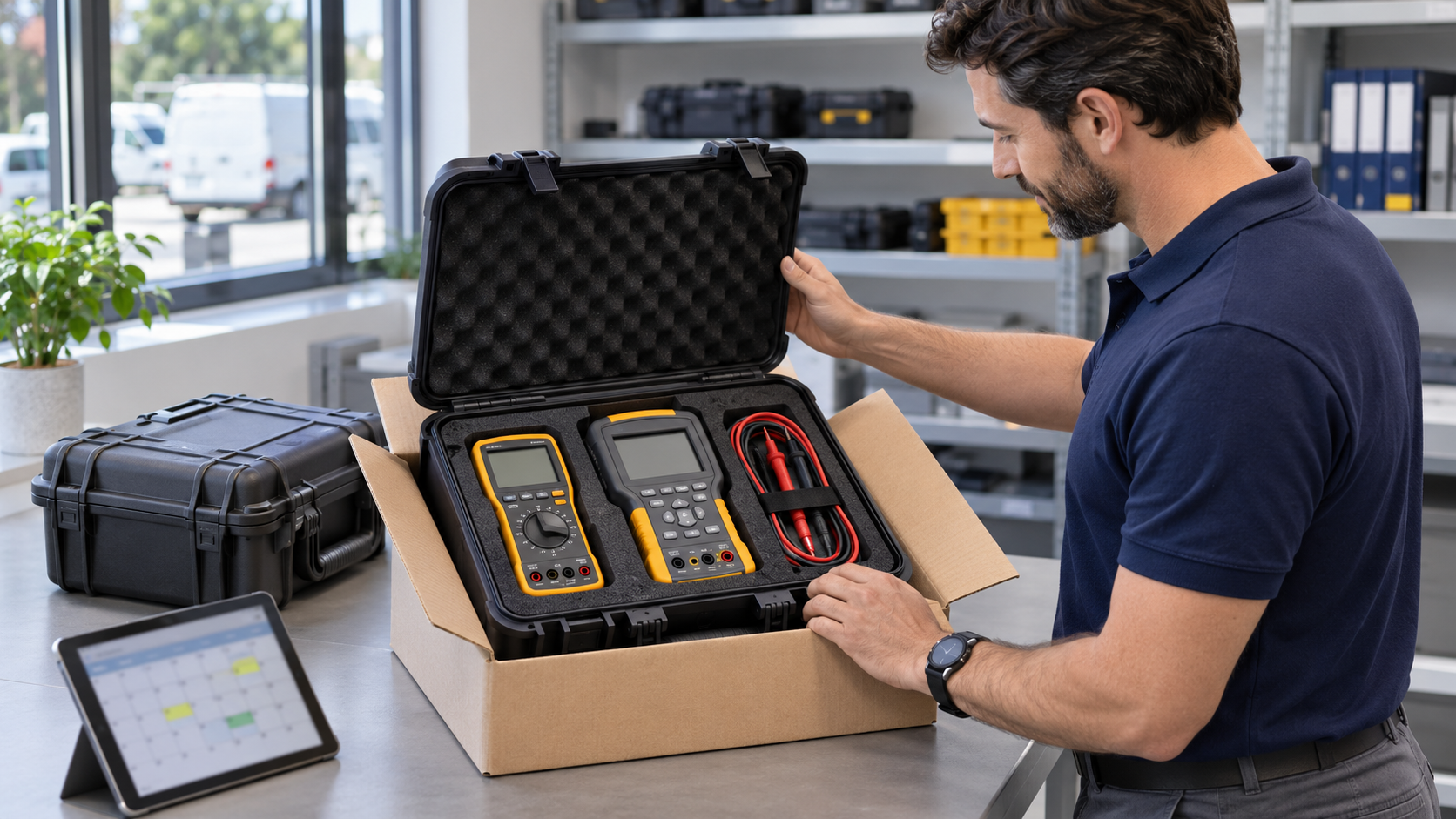
A calibration schedule for field service teams needs to answer more than “When is this instrument due?” It should also show when equipment needs to move, whether a suitable replacement is available, and how the exchange fits the engineer’s upcoming assignments.
Engineers may travel between customer locations, carry different combinations of test equipment, and receive assignment changes with little notice. Scheduling calibration without accounting for that work can leave a team with an avoidable equipment gap.
A practical calibration schedule connects due dates with upcoming assignments, equipment availability, shipping arrangements, and clear responsibilities. Here is how to build one.
Key Takeaways
- Plan calibration around engineer assignments, replacement availability, and shipping time.
- Confirm replacement equipment meets upcoming job requirements, and include receipt checks and outgoing returns in the schedule.
- Establish clear responsibilities for delivery updates and unexpected changes.
- SIMCO’s Field Service C.A.R.E. program puts these planning practices into action through coordinated replacement toolkit shipments and equipment returns.
1. Start with an Accurate Equipment List
Before planning shipments, confirm which instruments each engineer has and when they are due for calibration.
Your scheduling records should include:
- A unique identification number for each instrument.
- Instrument type and model.
- Assigned engineer or toolkit.
- Calibration due date.
- Current equipment location.
- Any known service issues or restrictions.
Track instruments individually, even when they travel together in a toolkit. Equipment in the same case may have different calibration due dates or service requirements.
Practical tip: Review the earliest due date in each toolkit. It may determine when an exchange needs to begin, even if the other instruments are not yet due.
2. Work Backward from the Due Date
Begin arranging service early enough to complete the steps needed before the instrument is due.
Work backward to account for these activities:
- Confirm upcoming assignments and equipment requirements.
- Identify a suitable replacement, if needed.
- Confirm its calibration status and availability.
- Verify the delivery address.
- Allow time for shipping.
- Allow the engineer to receive and check the equipment.
- Arrange the outgoing equipment’s return.
The time needed will vary by equipment, destination, and service arrangement. A domestic shipment to a fixed office requires different planning from a shipment to an engineer moving between customer sites.
For example, if an engineer leaves for an extended assignment shortly before an instrument is due, the exchange may need to happen before departure.
Practical tip: Put the replacement delivery date and outgoing return date on the schedule alongside the calibration due date.
3. Match Replacement Equipment to the Upcoming Work
Before arranging an exchange, confirm that the available replacement supports the work the engineer expects to perform. Depending on the application, this may involve checking:
- Measurement functions and ranges.
- Required measurement performance.
- Leads, adapters, probes, and other accessories.
- Compatibility with established service procedures.
- Calibration documentation.
- Customer or site requirements.
A replacement that arrives without a required adapter can create an equipment gap just as easily as a late shipment.
Practical tip: Maintain a short checklist for each common toolkit configuration. Use it when preparing shipments and when engineers receive them.
4. Choose an Exchange Approach That Fits the Assignment
Teams do not always need to handle calibration the same way.
| Approach | When it may help | What to plan |
|---|---|---|
| Exchange the full toolkit | Engineers use a consistent set of instruments | Confirm the replacement kit contains everything needed |
| Exchange individual instruments | Only certain items are approaching their due dates | Track each item and keep toolkit records current |
| Schedule service during a planned work gap | Suitable equipment will not be needed during that period | Confirm the gap allows for shipping, service, and return |
The right approach depends on equipment requirements, replacement inventory, and the engineer’s schedule. Confirm the plan with whoever controls field assignments, since a quiet week may fill up with new work.
5. Confirm Delivery Details Before Shipping
The engineer’s usual address may not be the right destination for the next exchange.
Before releasing a shipment, confirm:
- Where the engineer will be when it arrives.
- Who can accept delivery.
- Whether the location has receiving restrictions.
- How the engineer will access the package.
- Who should be contacted if delivery fails.
Assign responsibility for address verification. A record can look complete while still containing an outdated location.
Practical tip: Reconfirm delivery information close to shipment, especially when engineers travel frequently.
6. Close the Exchange After Delivery
After delivery, confirm that the engineer has received a complete toolkit suitable for the planned work.
The receiving process should include checking the instruments, accessories, condition, identification, and associated calibration records. Problems should be reported promptly so the team can respond before the next assignment.
The outgoing equipment also needs a clear return plan. Unreturned instruments can reduce the inventory available for future exchanges.
Record when the replacement was received and checked, when the outgoing equipment was shipped, and whether any issues remain open.
Practical tip: Track replacement receipt and outgoing equipment returns as separate activities so an exchange is not considered complete simply because the replacement shipment was delivered.
7. Plan for Exceptions
Decide in advance who handles common problems, such as a delayed shipment, damaged instrument, missing accessory, or last-minute assignment change.
Possible responses may include using another suitable instrument, arranging a loaner, changing the delivery destination, or adjusting the work schedule.
A shipping problem does not change an instrument’s established calibration due date. If an exchange cannot be completed as planned, follow your organization’s equipment-control procedures and involve the appropriate decision-maker.
Build a Schedule Around the Work Your Engineers Do
A useful calibration schedule shows how the team will have suitable equipment available while instruments move through service.
Start with accurate records, work backward from due dates, and make delivery checks and returns part of the plan.
SIMCO’s Calibrated Asset Readiness & Exchange (C.A.R.E.) program puts this planning approach into practice through coordinated toolkit exchanges. Calibrated replacement kits are shipped before outgoing equipment reaches its calibration due date, according to the customer’s established arrangements and subject to replacement availability and confirmed delivery details. By connecting replacement planning, shipments, and equipment returns, C.A.R.E. helps teams manage the steps that turn a calibration due date into a workable exchange schedule.
Need help planning calibration around your field team’s schedule? Explore how SIMCO C.A.R.E. can support your equipment exchange needs.
Explore SIMCO’s Field Service C.A.R.E. program
Frequently Asked Questions
How far ahead should we plan calibration
Plan far enough ahead to cover replacement availability, shipping, receipt checks, and any travel or access constraints. Equipment with limited replacement options may require earlier attention.
Should every instrument in a toolkit have the same due date
Not necessarily. Coordinating dates may simplify exchanges, but calibration intervals should reflect the organization’s requirements for the individual instruments. Scheduling convenience alone should not determine them.
What should we review when exchanges repeatedly run late
Look for the point where the process breaks down. Common causes include outdated addresses, limited replacement inventory, late planning, and outgoing equipment that has not been returned.