
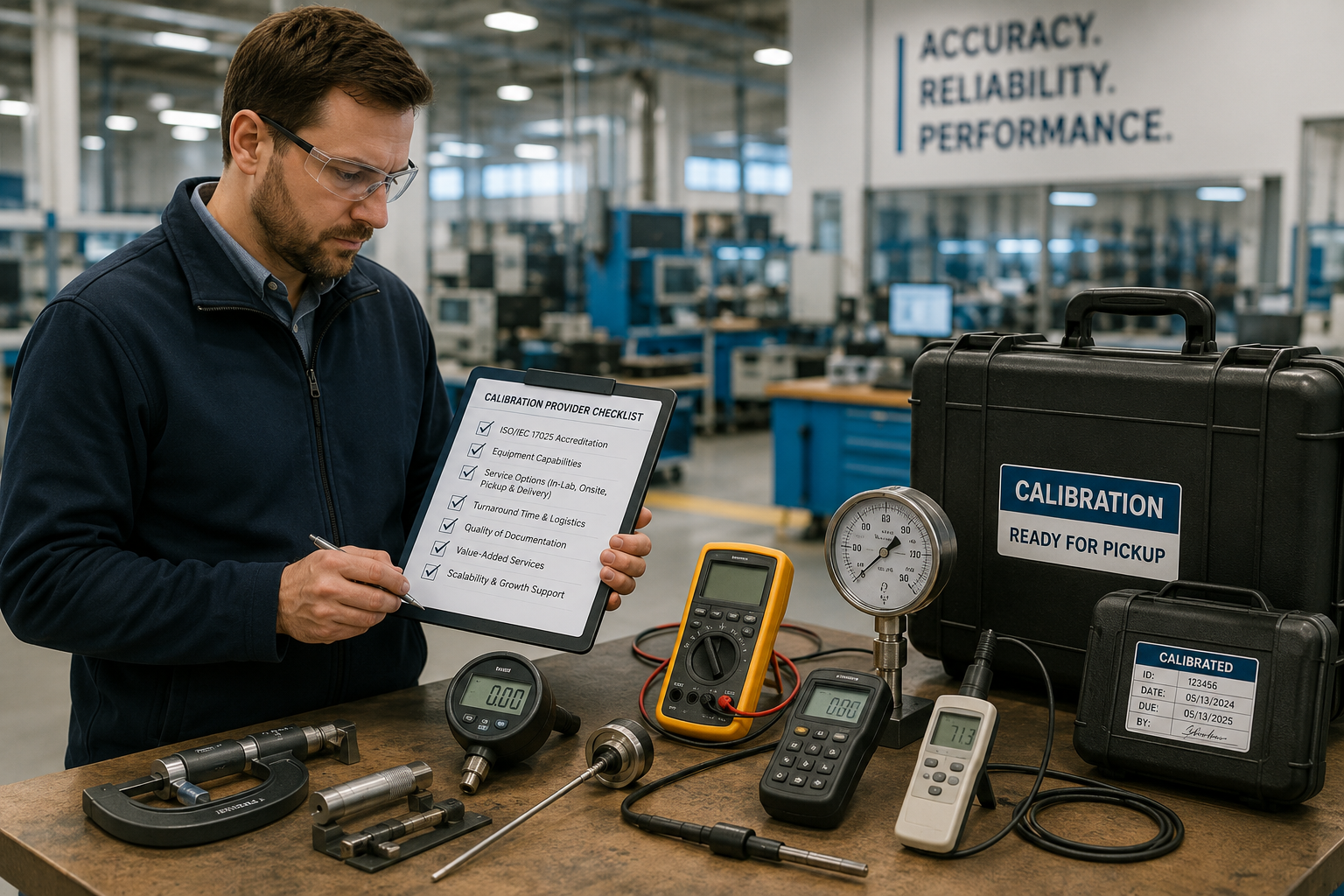
When equipment is due for calibration, many organizations begin with a simple online search for “calibration services near me.” While proximity may simplify logistics, choosing the right calibration provider involves far more than location.
The calibration provider you choose affects more than where your equipment is shipped. It influences turnaround times, audit readiness, documentation quality, and how smoothly your calibration program operates.
Whether you support manufacturing, aerospace and defense, medical devices, life sciences, energy, electronics, or another regulated industry, taking time to evaluate potential providers can reduce unnecessary downtime while helping you maintain compliance.
Here are seven factors to consider before selecting a calibration service provider.
1. Verify ISO/IEC 17025 Accreditation
Accreditation is one of the quickest ways to distinguish qualified calibration providers from those that simply offer calibration services.
An ISO/IEC 17025:2017 accredited laboratory has demonstrated that it operates under a quality management system and performs calibrations according to internationally recognized technical requirements. Accreditation also confirms that the laboratory has been independently assessed for competency within its accredited scope.
Non-accredited laboratories can perform calibrations, but accreditation provides independent evidence that a laboratory’s quality system and technical competence have been evaluated against internationally recognized requirements. For organizations operating in regulated industries, that additional level of confidence can simplify audits and support compliance efforts.
When evaluating providers, ask questions such as:
- Is the laboratory accredited to ISO/IEC 17025:2017?
- Does its scope of accreditation support measurements and tolerances?
- Are calibrations traceable to the SI through a national metrology institute such as NIST?
- Can the provider support your industry’s compliance requirements?
Not every laboratory is accredited for every type of instrument. Reviewing a provider’s scope of accreditation helps confirm that your equipment can be calibrated under the appropriate technical requirements before work begins.
2. Confirm They Have Experience with Your Equipment
A laboratory may be highly qualified yet still not support the measurements your organization relies on. Before sending equipment out for calibration, confirm the provider routinely works with the types of measurements and tolerances or uncertainties you use every day.
Common calibration capabilities include:
- Electrical test equipment
- Pressure instruments
- Temperature equipment
- RF and microwave equipment
- Dimensional measurement tools
- Pipettes
- Torque tools
- Balances and scales
Organizations with diverse equipment inventories often benefit from working with a provider that offers a broad range of calibration capabilities. Consolidating services with one provider can simplify scheduling, reduce administrative work, and eliminate the need to coordinate multiple calibration vendors.
3. Consider Service Options, Not Just Location
Searching for “calibration services near me” often leads to the assumption that the closest laboratory is the best option. But service capabilities frequently matter more than geography.
Many providers support customers through regional service networks that offer several ways to receive calibration services, including:
- Accredited in-lab calibration
- Onsite calibration
- Scheduled pickup and delivery
- Support for multiple facilities
- Regional service coverage
These options allow organizations to choose the service model that best fits their equipment, production schedules, and operational requirements. A provider with a well-developed service network may offer greater flexibility than one with a single nearby laboratory.
Finding Calibration Services Near You
If you’re evaluating providers based on location, look beyond the address of a single laboratory. Many national calibration providers operate through regional service areas that offer local pickup and delivery, onsite calibration, and access to accredited laboratories. A broader service network can provide access to more technical capabilities while simplifying scheduling and reducing unnecessary equipment movement.
4. Evaluate Turnaround Time and Logistics
Every day an instrument waits for calibration is another day it cannot support production, testing, or inspection. Understanding a provider’s turnaround process helps you plan maintenance schedules, minimize downtime, and avoid unnecessary delays.
Ask potential providers about:
- Standard turnaround times
- Expedited calibration options
- Equipment pickup scheduling
- Onsite service availability
- Asset status and tracking visibility
- Support during planned shutdowns or critical production periods
Fast turnaround is only part of the equation. Clear communication, predictable scheduling, and visibility into equipment status make it easier to keep calibration activities aligned with production demands.
5. Review the Quality of Their Documentation
Documentation becomes the evidence your organization relies on during audits, investigations, and quality reviews. The quality of a provider’s calibration records matters long after the work itself has been completed.
A complete calibration certificate should include information such as:
- Calibration results
- Measurement uncertainty
- Traceability to the SI
- As-found and as-left data, when applicable
- Decision rules, when required
- Electronic record availability
Complete records make it easier to demonstrate compliance, defend measurement decisions, and maintain confidence in equipment performance throughout its service life.
6. Look Beyond Calibration
Completing a calibration addresses today’s requirement. Managing hundreds or thousands of instruments over time requires a broader approach. Many organizations benefit from working with a provider that offers services beyond calibration, including:
- Instrument repair
- Calibration asset management
- Recall notifications
- Compliance reporting
- Support for multiple locations
Bringing these services together under one provider can reduce administrative effort, improve visibility across your calibration program, and help ensure equipment stays on schedule. Instead of coordinating multiple vendors and disconnected records, your team can manage calibration activities through a more consistent process.
7. Choose a Provider That Can GrowwithYou
The provider that supports one facility today should also be able to support your organization as it grows. New locations, additional equipment, and changing regulatory requirements all place new demands on a calibration program.
As you evaluate providers, consider whether they can support:
- Multiple facilities
- Standardized calibration processes
- Consistent documentation
- Broad technical capabilities
- Regional or national service coverage
Choosing a provider with the capacity to grow alongside your organization helps create consistency across locations, simplifies program management, and reduces the need to transition providers as your operational needs evolve.
Conclusion
Searching for “calibration services near me” is a logical place to begin, but choosing the right provider requires a broader evaluation.
Accreditation, technical capabilities, documentation quality, flexible service options, and responsive support all contribute to a stronger calibration program. Looking beyond proximity helps ensure equipment remains compliant, available, and ready when your operation depends on it.
SIMCO supports organizations across the United States through more than 15 Calibration Service Areas, offering accredited in-lab calibration, onsite calibration, pickup and delivery, and calibration management services for thousands of equipment types.
Find Calibration Services Near You
Frequently Asked Questions
How do I find accredited calibration services near me?
Start by looking for providers with ISO/IEC 17025:2017 accredited laboratories. Review each laboratory’s scope of accreditation to confirm it calibrates your specific equipment, then compare available service options such as in-lab calibration, onsite calibration, and pickup and delivery.
Is the closest calibration laboratory always the best choice?
Not necessarily. The nearest laboratory may not offer the capabilities or service options your organization needs. Providers with regional service networks often deliver broader technical expertise, flexible scheduling, and support for multiple facilities.
What is the difference between onsite and in-lab calibration?
In-lab calibration is performed in a controlled laboratory environment using specialized equipment. Onsite calibration is performed at your facility, helping reduce transportation time and minimizing downtime for qualifying instruments.
Why is ISO/IEC 17025 accreditation important?
ISO/IEC 17025 accreditation demonstrates that a laboratory has been independently assessed for technical competence and operates according to internationally recognized quality requirements. It provides confidence that calibrations are performed using validated methods, qualified personnel, and appropriate measurement standards within the laboratory’s accredited scope.
Can one calibration provider support multiple facilities?
Many national calibration providers offer standardized processes, centralized documentation, onsite services, and regional coverage that simplify calibration management across multiple locations.