

What Are Network Analyzers?
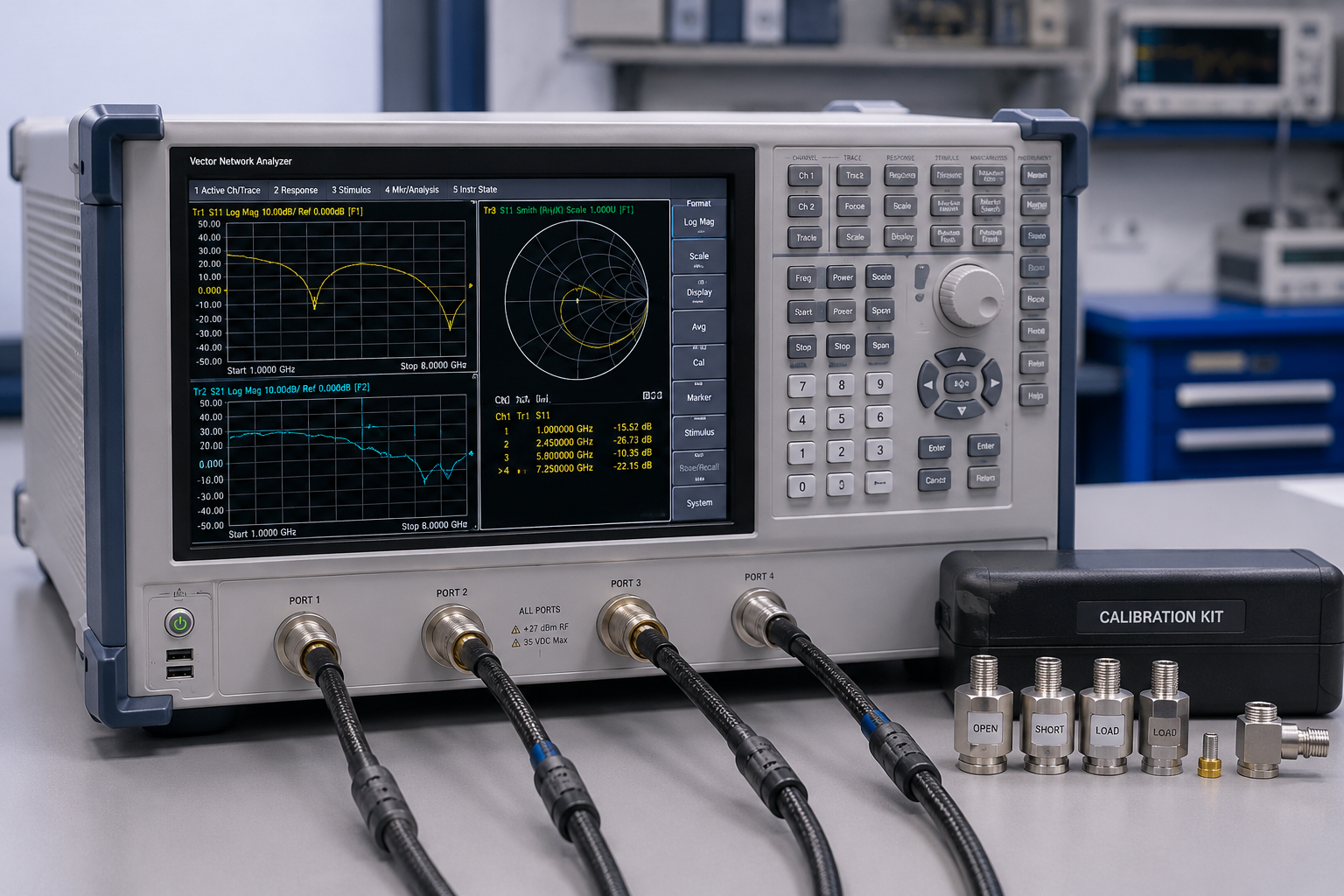 Network analyzers are precision electronic test instruments used to characterize how radio frequency (RF) and microwave signals pass through and reflect from components, devices, and systems. They help engineers, manufacturers, maintenance teams, and quality professionals evaluate RF performance, troubleshoot problems, verify designs, and validate components used in high-frequency systems.
Vector network analyzers (VNAs) characterize both the magnitude and phase of transmitted and reflected signals. These measurements are commonly expressed as scattering parameters, or S-parameters, such as S11, S21, S12, and S22. They can be used to evaluate characteristics such as insertion loss, return loss, impedance, gain, isolation, phase, and group delay.
Scalar network analyzers (SNAs) measure signal magnitude without phase information. They are commonly used for applications such as insertion loss and return loss measurements where full vector information is not required.
Network analyzers are used throughout aerospace and defense, telecommunications, semiconductor and electronics manufacturing, research and development, automotive electronics, and other applications where RF and microwave performance matters. Because network analyzer measurements can influence design decisions, component acceptance, troubleshooting, and system performance, periodic calibration helps confirm that instrument performance remains within applicable requirements and that measurement results remain reliable.
Common Network Analyzer Functions
SIMCO supports calibration for network analyzers with common measurement functions, including:
- S-parameter measurements, including S11, S21, S12, and S22 where supported
- Insertion loss measurements
- Return loss measurements
- Reflection coefficient measurements
- Impedance measurements
- Gain and transmission measurements
- Isolation measurements
- Phase measurements
- Group delay measurements where supported
- Frequency accuracy and related RF measurement parameters
Available calibration capabilities vary by instrument manufacturer, model, frequency range, connector type, configuration, and installed options.
Network Analyzer Calibration Capabilities
SIMCO provides network analyzer calibration services designed to verify measurement performance, identify measurement drift, and support measurement traceability for quality, compliance, engineering, and measurement assurance programs.
Our network analyzer calibration services may include:
- Inspection of instrument condition, RF connectors, ports, display, controls, and accessories
- Verification of frequency and RF measurement performance
- Verification of supported S-parameter measurements
- Verification of insertion loss and return loss measurement performance
- Verification of magnitude and phase performance where applicable
- Verification of impedance, gain, isolation, and group delay functions where supported
- Calibration using appropriate RF and microwave reference standards, documented procedures, and established measurement processes
- Adjustment when supported by the instrument and service scope
- As-found and as-left results when required
- Calibration certificates documenting applicable measurement results, tolerances, measurement uncertainty, and measurement traceability based on the selected calibration service level
SIMCO supports vector network analyzers, scalar network analyzers, and related configurations from major RF and microwave test equipment manufacturers. Specific capabilities depend on instrument model, frequency range, connector type, installed options, and required calibration level.
Why Network Analyzer Calibration Matters
Network analyzers can drift over time due to normal use, component aging, transportation, environmental conditions, connector wear, and exposure to changing temperatures. Because network analyzers make complex RF measurements across broad frequency ranges, changes in instrument performance may not always be obvious during routine use.
Even relatively small measurement errors can affect the characterization of antennas, filters, amplifiers, cables, connectors, transmission lines, and other RF components. In engineering or production environments, inaccurate measurements can contribute to incorrect design decisions, unnecessary troubleshooting, rejected components, quality escapes, or unexpected RF system performance.
Calibration helps support:
- Measurement accuracy: Confirms network analyzer performance against defined specifications using appropriate reference standards and measurement procedures.
- Measurement traceability: Provides documented calibration results with metrological traceability to the International System of Units (SI) through an unbroken chain of calibrations, each contributing to measurement uncertainty.
- Compliance and audit readiness: Provides calibration documentation supporting quality systems, customer requirements, and regulated applications.
- Risk reduction: Helps reduce the risk of decisions being made using inaccurate RF measurement results.
- Operational confidence: Supports consistent network analyzer measurements across engineering, manufacturing, maintenance, research, and quality activities.
It is important to distinguish periodic instrument calibration from the user calibration or error-correction process performed before many VNA measurements. Techniques such as SOLT, TRL, and electronic calibration characterize and correct systematic errors associated with the measurement setup, while periodic instrument calibration evaluates the underlying performance of the network analyzer against specified requirements. Both can be important to obtaining reliable measurement results.
Calibration Service Options
SIMCO supports calibration programs through a range of service models designed to meet different operational, compliance, and turnaround requirements. Depending on your instrument type, service scope, location, frequency range, and quality requirements, available options may include:
- In-Lab Calibration: Instruments calibrated through SIMCO’s ISO/IEC 17025 accredited laboratory network.
- Onsite Calibration: Available for selected instruments and customer applications where appropriate.
- Embedded Laboratories: Onsite, fully managed calibration laboratories.
- Managed Services: Coordinated third-party calibration management for capabilities requiring specialized support.
- Pickup and Delivery: Local pickup and delivery options available in many SIMCO service areas.
Explore Calibration Service Types
Industries and Applications We Support
SIMCO supports network analyzer calibration for organizations where RF and microwave measurement accuracy, traceability, and measurement confidence are important.
Common applications include:
- Aerospace and defense radar, communications, antennas, electronic warfare, and RF systems
- Telecommunications and wireless network infrastructure
- Satellite and space communications
- Semiconductor and electronics manufacturing
- RF component characterization and production testing
- Automotive radar and connected vehicle technologies
- Research and development laboratories
- Product design, verification, and validation
- Engineering, maintenance, and field service organizations
- Quality control and compliance laboratories
Why Choose SIMCO for Network Analyzer Calibration?
- ISO/IEC 17025 accredited calibration services
- Calibration support for vector network analyzers, scalar network analyzers, and related RF test equipment
- Calibration certificates supporting quality systems, audits, and measurement traceability
- Reported measurement uncertainty with accredited calibration services
- As-found and as-left data available when required
- Calibration support for regulated and high-technology industries
- Flexible service options, including in-laboratory calibration, embedded laboratories, managed services, and pickup and delivery, with onsite calibration available for selected instruments and applications
- Asset management support through CERDAAC SIMCO Manager